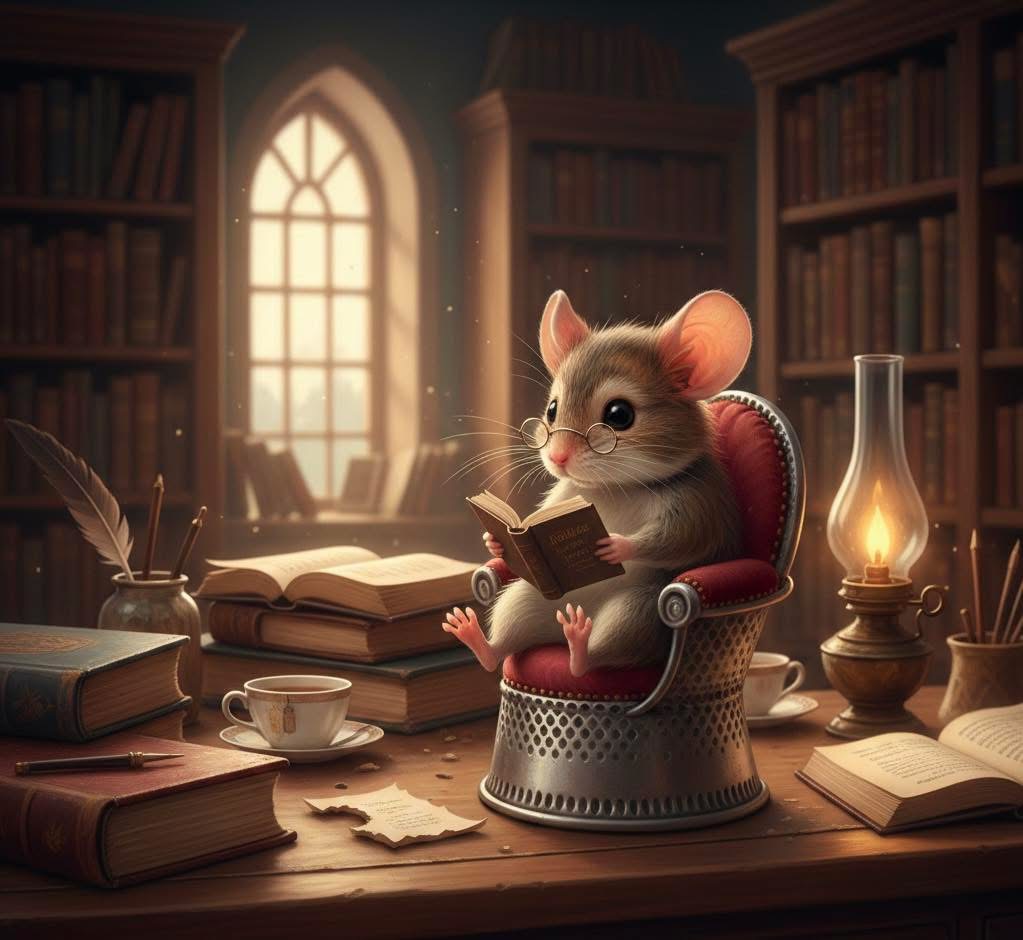
The Tiny Editor of Oak Street Library
The library was usually the quietest, most peaceful place in town, but
recently it had become a bit restless, with whispers like “Hey! Where did the ending go?” and “My book stops right at the best part!”
Lisa, the kind-hearted librarian, was puzzled and feeling a little helpless. She had tried everything to catch the mysterious page-thief. She even stayed up late in her cozy, velvet armchair, holding a flashlight and a book of her own. But the gentle flip-flip-flip of the pages always lulled her to sleep.
One night, Lisa was awakened by a soft scritch-scratch sound. She blinked her sleepy eyes and saw, sitting calmly on her mahogany desk, a small mouse. But this was no ordinary mouse. It wore tiny, round wire glasses and held a crumpled piece of paper—a page from a fairy tale.
Lisa’s breath caught in her throat. She stayed very still, not wanting to startle her visitor. The mouse looked up, adjusted her glasses, and sighed deeply.
“I suppose you’re going to set out one of those kitchen snap-traps now,” the mouse said softly, her voice quiet as a falling leaf.
“You… you can talk?” Lisa whispered, her heart aching for the little creature. “And you’re the one eating my happy endings!”
“I don’t eat them for the taste,” the mouse replied sadly, clutching her fragile paper to her chest. “My name is Matilda. And the truth is… I feel very lonely. When I read stories with happy endings where everyone finds a friend or a home, it makes me feel so sad that I don’t have those things for myself. I thought if I took the pages, I could hold onto a bit of that happiness in my cozy hole behind the encyclopedia section.”
Lisa’s heart softened. She looked at the traps she had set earlier and felt a wave of remorse. Lisa gently reached out and patted Matilda’s tiny head. “Oh, Matilda. You don’t need to steal happy endings. You can be part of them.”
The next morning, the library looked a little different. Every single mousetrap was gone. A simple, hand-painted sign by the front door read: “Storytime at 4:00 PM—Featuring our Friendly Librarian, Matilda.” Lisa even placed a tiny, thimble-sized chair right next to her own.
Now, when children come to visit, they don’t find pages missing. Instead, they find Matilda sitting quietly on the desk, her tiny glasses on, helping Lisa gently turn the pages. Matilda understands that stories become even more meaningful when shared with a caring friend. Lisa also realizes that sometimes what we see as a pest might be a lonely soul in need of kindness.
And as for the missing pages? Matilda helped Lisa carefully tape each one back into place—except for one tiny scrap of “Happily Ever After,” which she kept as a tiny rug for her cozy new home under the desk.
Later, children wrote a poem about this tiny editor.
The Librarian in Miniature
With whiskers long and glasses round,
The smallest reader can be found.
She doesn’t nibble, she doesn’t chew,
She loves the stories just as much as we do!
Upon the desk, she takes her seat,
With tiny paws and velvet feet.
Lisa turned a “pest” into a friend,
And helped to fix each happy ending.
So if you visit Oak Street’s hall,
Be sure to wave, though she is small.
For books are magic, this is true,
Especially when shared by two.
Erika P. Hamlet
(©️All rights reserved )
P.S. Wishing my little friend, Paige, only happiness throughout her entire life!❤️
**********
The Enigma of the Golden Ring
-The Forgotten Inheritance-
In the warm, dusty attic of her late grandmother’s charming Victorian mansion in New Orleans, Eliza Thorne happily explored decades of treasured secrets. The air was filled with the nostalgic echoes of long-ago jazz, and tiny dust motes danced in the gentle sunlight. Eliza, a 32-year-old historian passionate about occult artifacts, had inherited the house with a curious note in the will: “Look for the book that isn’t, and remember—truth is the sharpest blade.”
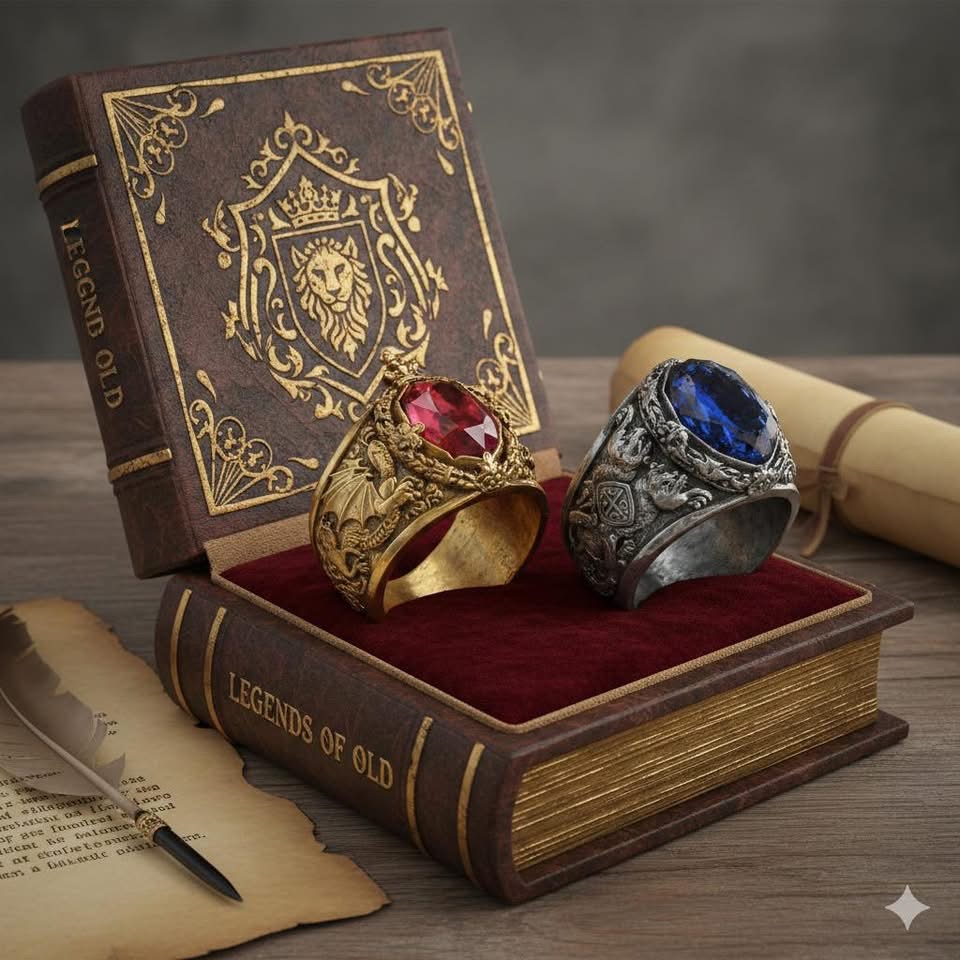
She initially thought Nana was being theatrical, but amid the clutter, a large box caught her eye. Shaped like an old book, its leather cover was cracked from years of history, and the spine bore the faded gold title Arcana Obscura. Heavier than it looked, it took some effort to pull free. When she opened it, it wasn’t pages inside, but a velvet-lined hollow holding a huge golden ring—the size of a serving platter, engraved with swirling symbols. Inscribed on its inner rim were the words: “Use me right and get the price – use me wrong, get the hell.”
Eliza’s breath hitched as the ring shimmered with an unnatural warmth. Could it be a relic connected to her family’s rumored secret society ties? She gently pocketed it, but as she started down the stairs, a sudden chill ran down her spine. A shadow flickered at the corner of her eye—gone when she turned to look. It felt as if there were whispers from the past.
At the New Orleans Historical Society, archivist Mr. Hargrove carefully examined old photos of the mysterious ring. “This motto… It’s from the Crescent City Brotherhood, a secret group of alchemists and smugglers from the 19th century. They believed in ‘judgment artifacts’ that rewarded good deeds and punished wrongdoings,’ he explained, pulling out a dusty ledger. The ledger revealed interesting entries about Elias Thorne, Eliza’s great-great-grandfather, who mysteriously disappeared in 1865 after hiding what he called a “golden gate to fortune.”
Feeling curious, Eliza looked closer. She twisted the notches on the ring and discovered a hidden compartment with a tiny parchment scroll inside: The message read, “The price is truth; hell is lies. Seek the mirror of the bayou, but beware the false reflection.”
Later that night, her hotel room phone unexpectedly rang—an anonymous voice whispered, “The ring isn’t yours. Return it, or face hell.” Then, the line went dead. Eliza’s mind raced with questions—was she being watched?” However, this did not deter her from the idea she wanted to implement.
Hiring bayou guide Remy LeBlanc, a weathered Cajun with tales of voodoo, Eliza ventured into the swamps. “That ring’s cursed,” he warned. “Folks say it shows your true self.” At the mirror-like pond, moonlight through the ring projected a map to an underwater cave.
Diving in, they found not just treasure chests, but a skeleton clutching a journal. It was Elias Thorne’s confession of the Brotherhood’s dark secret: the ring was forged from cursed gold, stolen from a Haitian ritual. It granted wealth to the honest but doomed the deceitful.
As they surfaced with a chest of gold, Remy turned treacherous. “My family’s been huntin’ this for generations.” In the scuffle, the ring activated wrongly in his grip—a whirlpool swallowed him. Eliza escaped with the journal, but the chest sank too.
Back ashore, she discovered the journal’s ink fading—revealing a hidden message: The true price lies in the bloodline. Find the twin. Shaken, Eliza set out to research her family tree. A shocking revelation: Nana had a twin sister, Evelyn, presumed dead in a childhood accident. But records hinted Evelyn survived, living under an alias as a recluse in Baton Rouge. Driving there, Eliza confronted Evelyn, now a frail woman in a cluttered bungalow. “The ring chose you,” Evelyn rasped. “But it’s a test. Our family cursed it to protect a greater secret—a map to the Brotherhood’s vault, hidden in the French Quarter.” Evelyn handed over a locket with a micro-map. But as Eliza left, gunshots rang out. Evelyn slumped, whispering, “Beware Hargrove… he’s not who he seems.”
Fleeing assassins, Eliza pieced it together. Hargrove wasn’t an archivist—he was a modern Brotherhood descendant, using her to locate the ring. The anonymous call? His doing.
She infiltrated the French Quarter’s underground tunnels, guided by the map. There, a vault brimmed with artifacts: potions, grimoires, and a pedestal for the ring. Inserting it “right”—aligning symbols with truth runes—she unlocked a compartment revealing bonds worth billions, tied to forgotten oil fields. The vault’s alarm triggered. Hargrove appeared with goons.
“You used it right, but the price is sharing.” A fight ensued; Eliza deliberately twisted the ring, summoning illusions of hellish flames that terrified the thugs into flight. Hargrove grabbed the ring, but it burned his hand—exposing his lies about his lineage. He confessed: He was Evelyn’s illegitimate son, Eliza’s uncle, driven by greed. In the chaos, the vault collapsed partially, burying Hargrove. Eliza escaped with evidence to expose the Brotherhood’s remnants.
Months later, Eliza, now wealthy and authoring a book on the saga, received a package at her new home. Another book-like box. Inside: a silver ring, twin to the gold one, inscribed: “The hell was a lie; the price is eternal.” Opening it activated a vision—Elias Thorne’s ghost: “The rings are paired. One for truth, one for redemption. Use both to break the curse.” But as the vision faded, Eliza heard footsteps outside. The Brotherhood wasn’t done. A note slipped under her door: “We have your ‘twin’—the ring. Come alone.” And here starts the cycle of mystery.
Eliza stood at the bayou’s edge once more, both rings in hand. Twisting them together “right,” a portal shimmered—not to treasure, but to closure. The curse lifted, ghosts laid to rest. Yet, in the ripples, she saw futures branching—warnings of new seekers. The enigma of the golden ring endured, a reminder: Truth’s price is steep, but lies’ hell is steeper. And in New Orleans’ shadows, mysteries never truly end.
—Erika P. Hamlet
(©all rights reserved)
**********

Not Just a Coffee Grinder
In a quiet town blanketed by snow, a family moved through their days, their love spoken in gestures rather than words. On a brisk autumn afternoon, thirteen-year-old Adela, brimming with curiosity and resolve, stepped into a home goods store with her father. She had saved every coin from chores and birthdays, determined to find the perfect birthday present for her mother. Clutching her little wallet, she wandered the aisles until her eyes landed on a hand-carved wood-and-brass coffee grinder, its surface glowing with the warmth of years gone by, hinting at patience and cherished rituals. Her heart leapt—this was the one. The saleswoman, touched by Adela’s earnestness, wrapped the grinder with care and whispered, “This grinder has a certain magic, you know.” Adela and her father exchanged a smile, grateful for the kindness, and left the shop with pride.
When her mother unwrapped the gift, she beamed, kissed Adela’s forehead, and set the grinder high on a shelf, still preferring the convenience of store-bought ground coffee.
Seasons passed, and the grinder gathered dust. Then, during a fierce snowstorm, as warnings crackled from the radio, her mother stocked the pantry. The store was out of ground coffee, so she bought whole beans, thinking, “If we need to, we’ll finally use Adela’s gift.”
One evening, the house was hushed. Her husband was lost in the glow of the TV, the children already dreaming. Alone at the kitchen table, she poured beans into the grinder and turned the handle. The rich, earthy aroma rose up, swirling around her like a memory made real. She breathed it in, a gentle dizziness washing over her, and wandered to the armchair, where sleep quietly claimed her.
In her dream, the kitchen shimmered with golden light. Her mother, gone for a decade, appeared younger, smiling, her apron dusted with flour.
“Hi, Mom,” she whispered, tears springing to her eyes. “You would not believe how often I think of you. Show me again… those Christmas cookies you used to bake. I was always too busy to watch. I try now, but your recipe is lost.” Together, they moved in harmony—hands kneading dough, voices sharing secrets, laughter echoing through the warm, timeless kitchen.
Her husband found her asleep in the chair, head tilted, with a gentle smile on her lips. He touched her shoulder. “Sweetheart, you must be exhausted. Why not go to bed?”
“No,” she whispered, her eyes still faraway, “I need to write it down… the cookies… before I forget.”
The next morning, Adela spotted the grinder, still brimming with beans. Eager to lend a hand, she carried it to the kitchen, settled in, and began to turn the handle. The scent of fresh coffee blossomed, wrapping the house in warmth. Hoping to surprise her mother, she brought the grinder to her room. Nestled in her favorite chair, she gave the crank another turn, and as the aroma swirled around her, she drifted into a peaceful sleep, content and dreaming….
The scent swept her away, plunging her into a luminous underwater realm. Dolphins twirled in joyful spirals, rays drifted by like silk kites, and dazzling fish grazed her fingertips. She giggled, buoyant and unburdened, as if she had finally slipped into the magical world she had always longed to visit.
A gentle knock pulled her back to the present. Mom stood in the doorway, her eyes lighting up at the sight of the grinder in her daughter’s hands.
“I thought that was gone for good. Come on—let’s have breakfast, then go ice skating. Dad’s busy today, so I’ll be your chauffeur.”
They shared a cozy breakfast, laughter and stories weaving between bites. Soon after, they bundled up and set off for the skating rink.
The ice sparkled beneath the dazzling lights. Mom knelt to lace Adela’s skates, then offered her hand.
At first, Adela teetered, arms windmilling, but Mom’s steady grip gave her courage. They glided in slow circles, then gathered speed. Adela tried a spin; Mom showed her how with graceful ease.
Their laughter echoed as they raced, playfully nudged each other, and finally settled on a bench for steaming hot chocolate, cheeks aglow and hearts brimming. It was one of those rare afternoons when time stretches sweetly, and love seems endless.
Now alone, dad cleared the table with care trying to return the grinder to its shelf, beans still nestled inside—a quiet echo of their daily ritual. He checked the clock, sighed, and began to turn the handle. The aroma unfurled, rich and mesmerizing.
As he ground the beans, memories flooded in: his wife wandering past glittering shop windows, lingering over scarves and handbags she admired but never claimed, slipping into stores to buy shoes and sweaters for Adela, and a sweater for him that matched his favorite tie. He saw her weaving their lives together with quiet grace, always giving, never asking. Tears blurred his vision. Setting the grinder aside, he moved to the wardrobe—her dresses mingling with his shirts, each piece a memory. He called his office, then, heart full, hurried to his car and drove off, carried by a tide of love and longing.
He chose her most elegant dress, the one she had often gazed at through shop windows but never brought home, along with a lovely scarf and handbag. He arranged them tenderly on the bed, adding a note from the heart: “For the woman who cares for everything and asks for nothing. Thank you for being you.
Your loving husband.”
That evening, when Adela’s mom returned home, she found the beautiful surprise waiting for her. Tears shimmered in her eyes as she read the note.
Her husband had transformed the evening with a candlelit dinner for two. They lingered long into the night, sharing stories, laughter, and close embraces. Upstairs, Adela and her brother Josh admired their own meal, sneaking glances downstairs to make sure their parents were smiling.
From that moment on, the grinder was never forgotten again. The family affectionately called it “the magic grinder.” Dad would tease, “Be careful—one grind and you might start dreaming of dolphins or forgotten recipes!” Adela would say, “It’s the best gift ever. It brought Grandma back, even just for a moment.” Mom, softly: “Maybe it’s not magic… but it smells like love. And memories.”
On quiet nights when nostalgia whispered, someone would ask, “Time to grind some coffee?” Soon, the house brimmed with a comforting aroma that seemed to wrap everyone in memories, carrying them back to loved ones and moments they thought were lost.
The little grinder rested on the shelf, polished to a soft gleam, a quiet but powerful bridge between generations. It reminded them that love never vanishes; it simply waits for the right scent to guide it home.
The End
Erika Hamlet
(all rights reserved)
**********

The Great Acorn Caper of Whispering Pines
As the first golden rays kissed the ancient oaks, Cyril the squirrel launched into his signature morning routine: a triple-backflip off a lofty spruce, then a wild, tail-whipping survey of the forest below. Cyril was a bundle of boundless energy, his nerves always crackling just beneath his fur.
“Coast is clear,” he chattered. “No hawks. No foxes. No cats with bells.”
A neat, hidden burrow beneath the roots of the spruce revealed a twitching, striped nose—Pip the Chipmunk. While Cyril thrived in the dizzying heights, Pip ruled the secret tunnels below. He was a meticulous planner, and today his cheeks bulged comically, as if he’d tried to smuggle a pair of golf balls.
“You’re late, Cyril,” Pip grumbled, his voice muffled by his overstuffed cheeks. He popped out three perfect acorns, lining them up with precision. “The dew’s almost gone, the leaves are getting crunchier, and our stealth window is shrinking.
For weeks, the pair had been plotting around the legendary “Great Blue Tarp” behind the Ranger’s station. Word had fluttered in from a trustworthy, if slightly scatterbrained, Blue Jay: the Ranger had dropped a whole bag of premium roasted sunflower seeds by the woodpile.
Only the problem was that the woodpile was guarded by “Buster,” a Golden Retriever whose enthusiasm for chasing small mammals was only matched by his inability actually to catch them.
But anyway, these two have a strategy. Cyril would provide the “Aerial Distraction,” while Pip would perform the “Ground Sweep.”
Cyril zipped up the Ranger’s cabin, his claws drumming a frantic rhythm. Perched at the gutter, he let loose a volley of shrill scolds and lobbed a pebble that pinged off Buster’s nose, demanding the dog’s full attention.
The dog erupted into a flurry of barks, his tail wagging with joyful excitement as he spun in circles, looking everywhere except the ground, utterly thrilled by the commotion. Meanwhile, Pip became a streak of brown stripes, hugging the ground as he darted from the shadow of a fern to the rim of a flowerpot. At the Blue Tarp, he struck gold: not only sunflower seeds, but a treasure trove of dried cranberries.
“Cyril!” Pip hissed from the shadows. “It’s a buffet! Get down here!”
Fueled by the thrill of the moment, Cyril bounded forward and hurled himself in a daring leap toward the birdfeeder. In his excitement, he failed to spot the Ranger’s latest trap: a pole slicked with fresh grease.
Cyril let out a startled squeak as he hit the pole, sliding down like a furry firefighter and landing with a gentle thud right in front of Buster. The dog went rigid, eyes wide and body tense. Cyril’s whiskers quivered with fear, and for a heartbeat, even the breeze held its breath.
Pip sprang into action. Though fear squeezed his tiny chest, he knew brawn was useless against a dog. Instead, he snatched a big, brittle leaf and, paws shaking, rustled it wildly in the tall grass a few paces away, hoping his nerves would sell the act.
Buster’s ears twitched. A new sound! An unseen enemy! The dog swung his big head toward the grass, eyes bright with curiosity. In that split second, Pip dashed out, heart hammering, seized Cyril by the scruff, and yanked him beneath the porch steps.
An hour later, nestled deep in the hollow of an old log, the two friends basked in their hard-won relief, dividing the loot. Pip, still jittery from their close call, had managed to cram exactly three sunflower seeds and two cranberries into his cheeks during the mayhem—just about his limit.
“You saved my tail, Pip,” Cyril said with genuine gratitude, nibbling on a seed. His fur was still a bit ruffled from the slide, and his eyes were still wide from the lingering adrenaline. “I got a bit carried away with the acting.”
Pip adjusted his tiny paws and nodded warmly, pride and relief softening his features. “You were a great distraction, Cyril. But next time, let’s check the pole for grease before you make your grand exit.”
“Deal,” Cyril grinned. “Same time tomorrow for the birdfeeder on the East side?”
Pip sighed, but a small smile played on his face. “I’ll bring the map. You bring the acrobatics.”
As the sun melted into the horizon, it painted the sky with bruised purples and molten gold. Cyril saw this as his bedtime signal, but for the Night Watch, it marked the forest’s grand curtain rise.
“We lingered too long, Pip,” Cyril whispered, his usual twitchy energy replaced by a genuine shudder. He was perched on a low branch, peering into the deepening shadows of the Hemlock grove. “The shadows are starting to grow feathers.”
Pip pressed the earth over his secret stash, barely sparing a glance. “Nonsense. Once we slip past the fern-line, we disappear. But tuck your tail—right now, it’s a neon sign for anything with teeth.”
As they crept toward the clearing, the air grew heavy. The crickets’ nightly orchestra cut off mid-chirp, replaced by a silence so thick it pressed in like a wool blanket.
High above, a pair of eyes snapped open. They were two glowing amber orbs, vast and unblinking. This was Barnaby, a Great Horned Owl whose patience for “day-dwellers” was notoriously thin.
“Who,” a voice boomed—not a chirp or a bark, but a low, resonant vibration that rattled Pip’s whiskers. “Who is scuffing about in my carpet of moss?”
Cyril froze mid-stride, one paw hovering in the air. “It’s just us! The… uh… Daytime Relocation Committee!”
Barnaby drifted down, his enormous wings sweeping away the last scraps of starlight. He didn’t simply land; he seized the stump three feet away, looming over the trembling pair with a regal glare.
“You are loud,” Barnaby huffed, his feathers puffing out to make him look twice his size. “You chatter about seeds. You drop shells. You wake me during the prime dreaming hours of three in the afternoon.”
Pip, realizing that freezing wasn’t working, stepped forward with a shaky twitch of his nose. “Deepest apologies, Mr. Barnaby. We had a… tactical delay at the Ranger’s station. We are just passing through to our respective burrows.”
“Passing through?” Barnaby leaned in, the scent of old pine and cedar wafting off his wings. “The forest floor is a toll road at this hour. And the toll is silence.”
Cyril, spotting a glimmer of hope, piped up. “What if we strike a deal? You crave silence, right? But those ‘clicky-clack’ beetles under the creek log keep you up all night!”
Barnaby blinked slowly. The “clicky-clack” beetles were indeed a nuisance—crunchy, but far too noisy for a dignified owl’s nap.
“I am listening,” Barnaby droned.
“We know exactly where their main colony is,” Pip added, catching onto Cyril’s plan. “We can lead you there. You get a midnight snack and a quieter neighborhood, and we get a ‘Safe Passage’ pass until we reach the big oak.”
The owl considered this, his head swiveling nearly 180 degrees. “Very well. Lead on, stripe-back. But if I hear one more backflip-related chatter, the deal is off.”
It became a procession like no other: a squirrel and a chipmunk darting through tangled undergrowth, shadowed by a silent, hulking figure gliding above like a feathered guardian. At the beetle log, Barnaby landed with a heavy thud.
“Go,” the owl commanded, though his tone was marginally less icy. “And tell the Blue Jay to stop screaming at the sun. It’s tacky.”
Pip and Cyril shot off in a heartbeat, the last fifty yards vanishing in a blur of fur and frantic energy. Pip vanished into his burrow, Cyril scrambled up to his treetop nest, and they shared a final, breathless look.
“You know,” Cyril whispered from the heights. “He’s actually kind of cool when he’s not trying to eat us.”
“He’s still grumpy,” Pip replied from the safety of the dirt, close to his house. “But at least he’s a grumpy neighbor who likes beetle snacks.”
Pip’s home appeared to be just a hole beneath a twisted oak root. But past the entrance tunnel, with its clever mud-mat for paw cleaning, stretched an underground sanctuary that would make any civil engineer marvel. Pip’s house was a masterpiece of functional design and obsessive organization, where he suddenly disappeared.
The End
—Erika P. Hamlet
(all rights reserved)
**********

Santa Is Running Late
(© all rights reserved)
“Sorry I’m late—it’s almost February now, so it’s not Christmas anymore,” Santa said sheepishly as he sat up in bed. “Something happened to me, and Rudolf’s at fault.”
He rubbed his eyes and explained: “You know, Rudolf loves Christmas more than anything. His bright red nose? Well, honestly, it’s because he drinks quite a bit of fruit liqueur before the holidays. Let me clarify. Rudolf, the reindeer with the red nose, especially loved all kinds of fruit lemonades. But he drank them with joy, even after they expired. He got sick because of it— the fruit juices fermented slowly, and his stomach couldn’t handle it. That’s why he ended up in the so-called reindeer hospital.
Keep this secret—he’s stopped drinking now. When that happened, I couldn’t get him to pull the sleigh—his nose shining like a beacon and with a terrible headache—so I took him straight to the rehab center. He didn’t resist; he just sighed, whined a little, and kept complaining that his head, stomach, and whole body hurt.”
A few weeks later, Santa Claus came back for him.
On the center’s terrace, Rudolf sat in a rocking chair with one leg casually crossed over the other, happily smoking a cigar. He wore stylish red-rimmed glasses.
“Is that really you, Rudolf?” Santa asked, blinking in disbelief.
“You know perfectly well it’s me, Santa. Welcome. You’ve come for me,” Rudolf replied calmly.
Instead of joy, Santa’s knees nearly buckled. Disappointment clouded his eyes. “What happened to you, Rudolf? Where’s your red nose?”
“Well, when they cured me of drinking,” Rudolf said cheerfully, “the red nose just… disappeared. But don’t worry, Santa—I’ve got these red-framed glasses now. Problem solved!”
“That can’t be true,” Santa moaned. “You don’t have your famous red nose anymore…”
“I don’t know what you want from me,” Rudolf sighed. “When I drank fruit punch and had a red nose, it was bad. Now that I don’t have it, it’s bad again. Make up your mind!”
“And Rudolf… you never used to smoke cigars,” Santa pointed out. “Where did you even get those?”
“From a little elf named Trapril,” Rudolf answered promptly, flashing a grin.
“Trapril?” Santa echoed. “Isn’t that the one who asked me for a cigar for his dad last Christmas?”
“Yes, that’s him,” Rudolf nodded, now completely nose-less except for those fashionable red frames.
“But Rudolf, that’s theft! You can’t just take things that aren’t yours,” Santa gently scolded.
“How do you know it’s not mine?” Rudolf countered. “I adopted Trapril. I’m his dad now.”
Santa pressed a hand to his forehead. “Oh, I think everything is starting to give me a headache…
“See, at least now you know what it feels like when my head, stomach, and whole body hurt.”
Santa thought for a moment, then muttered, “Rudolf, you can’t possibly go on without a red nose. We’ll have to paint one on you… or glue one. We need to do something!”
“No way, boss,” Rudolf stamped his hoof firmly. “No ho-ho-ho without a proper employment contract!”
“What are you talking about?” Santa asked, bewildered. “What kind of employment contract? You belong to us—to the other reindeer and me!”
“I can belong to myself just fine,” Rudolf replied, taking another slow drag on his cigar and blowing perfect smoke rings. “But if I’m going to work, I want a contract. Since you don’t give us anything, if I get nothing, I’ll just sit here in this rocking chair and puff away all day.”
Santa scratched behind his ears, thinking hard. After a long pause, he asked nervously, “And… what exactly should I write in this contract to satisfy you?”
“I want to keep this rocking chair,” Rudolf said firmly. “Buy me a box of cigars every month, and I’ll take Trapril with me — I might need him for something good one day. Listen, Santa – Boss, have you ever thought about providing us with fancy red shorts?”
“Red shorts?” screamed Santa, adding, “And what for? My reindeer have never asked me for this!”
“I know. We never have, but think about it. It’s global warming, and if we fly throughout Australia, we are going to be very hot! Did you see people there sitting on the beach, drinking pina coladas? Oh, by the way, can we have a rest on the beach too and have a pina colada?”
“Oh, dear reindeer, have you completely lost your mind! Pina coladas are not for reindeer. Do you want to get sick again?” reprimanded him, Santa.
“So when we can’t have a pina colada, we can have a reindeer colada, right, boss? And don’t forget about the cigars!” reminded him, Rudolf, now without a red nose.
“No, no, no!” Santa burst out. “You’re not getting any cigars — they’re unhealthy! And why are you pulling on my sleeve? Why are you pulling me—?”
“Santa! Santa, wake up! For heaven’s sake, what’s wrong?” Mrs. Claus’s voice cut through the haze.
Santa’s eyes flew open. He was back in his own bed.
“Am I… not in rehab?” Santa mumbled, feeling puzzled. “So I don’t have to buy cigars or sign any contracts?”
Mrs. Claus stared at him, hands on her hips. “Santa, what are you even talking about? It’s past nine o’clock! What cigars? What rehab? I’m not even sure you’ve fully recovered from that awful flu yet.”
“So… I was just sleeping?” Santa said slowly, a relieved smile spreading across his face. “It was just a dream. Thank goodness! How long did I actually sleep?”
“Quite a long time,” Mrs. Claus answered softly. “You had a really bad case of the flu. I was so worried. And there are still presents waiting — you never delivered them.”
“Oh, thank goodness I had the flu,” Santa chuckled. “Thank goodness I was sick. I’m completely healthy now!”
Mrs. Claus rolled her eyes, unable to believe her ears. “But you were acting very strange, you wanted to sit than fight. I was worried about you!”
“Oh, I’m fine! And… what about Rudolf? Does he still smoke cigars?” Santa asked, his eyes wide with lingering confusion.
“For heaven’s sake, what cigars?” Mrs. Claus laughed. “Rudolf has his red nose, and he’s perfectly happy — just like in the song everyone loves. Are you sure you’re feeling all right?”
“I’m absolutely sure,” Santa declared, already throwing back the covers. “I’m relieved! Now, I need to hurry and deliver those late, forgotten gifts. Ho, ho, ho!”
He jumped out of bed, full of energy again.
“By the way, why does Rudolf actually have that red nose?” Santa asked and playfully rolling his eyes as if expecting a silly answer, like maybe he painted it himself or it was a holiday magic trick.
Mrs. Claus smiled and shrugged. “Probably for the same reason yours turns red when it’s cold — some of us are just sensitive to winter.”
Santa thought for a second, then grinned. “Hmm… instead of cigars, we should get him a warm scarf! A nice thick one he can wrap around his neck, his ears, and that famous nose so he stays cozy.”
Mrs. Claus threw her hands up in mock exasperation. “Cigars again? If you don’t stop this nonsense right now, you’re going straight into retirement!”
“No, no retirement for me!” Santa laughed. “There’d be no Christmas without Santa!” He quickly dressed (with Mrs. Claus’s helpful assistance), checked himself in the mirror, and patted his round belly with pride — then paused. “I believe my Rudolf is just right!”
—Erika P. Hamlet