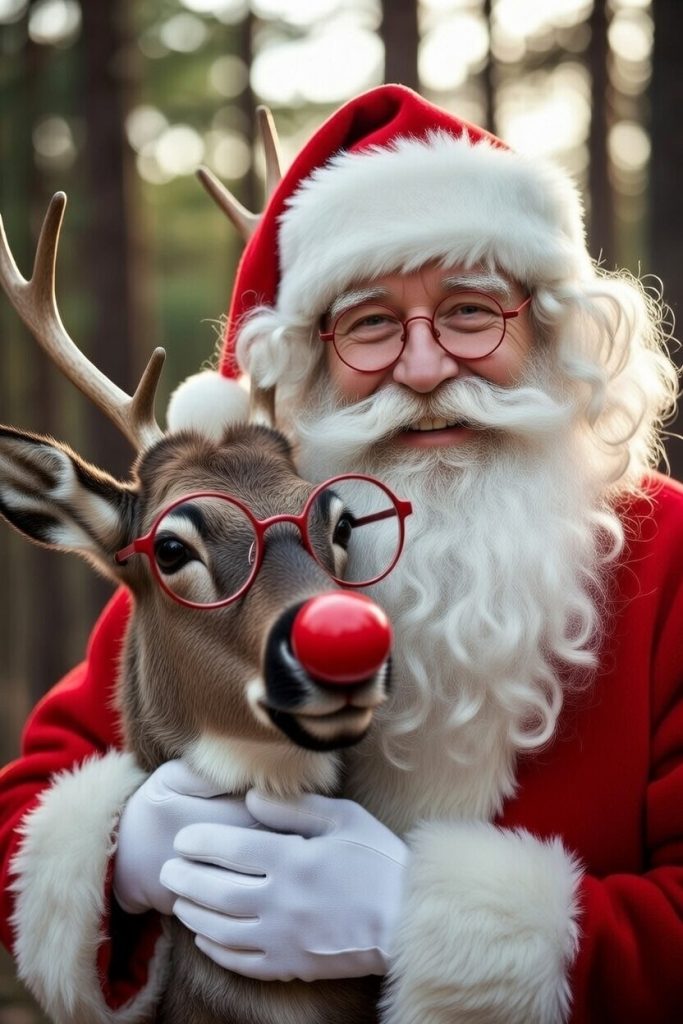
Santa Is Running Late.
(© all rights reserved)
“Sorry I’m late—it’s almost February now, so it’s not Christmas anymore,” Santa said sheepishly as he sat up in bed. “Something happened to me, and Rudolf’s at fault.”
He rubbed his eyes and explained: “You know, Rudolf loves Christmas more than anything. His bright red nose? Well, honestly, it’s because he drinks quite a bit of fruit liqueur before the holidays. Let me clarify. Rudolf, the reindeer with the red nose, especially loved all kinds of fruit lemonades. But he drank them with joy, even after they expired. He got sick because of it— the fruit juices fermented slowly, and his stomach couldn’t handle it. That’s why he ended up in the so-called reindeer hospital.
Keep this secret—he’s stopped drinking now. When that happened, I couldn’t get him to pull the sleigh—his nose shining like a beacon and with a terrible headache—so I took him straight to the rehab center. He didn’t resist; he just sighed, whined a little, and kept complaining that his head, stomach, and whole body hurt.”
A few weeks later, Santa Claus came back for him.
On the center’s terrace, Rudolf sat in a rocking chair with one leg casually crossed over the other, happily smoking a cigar. He wore stylish red-rimmed glasses.
“Is that really you, Rudolf?” Santa asked, blinking in disbelief.
“You know perfectly well it’s me, Santa. Welcome. You’ve come for me,” Rudolf replied calmly.
Instead of joy, Santa’s knees nearly buckled. Disappointment clouded his eyes. “What happened to you, Rudolf? Where’s your red nose?”
“Well, when they cured me of drinking,” Rudolf said cheerfully, “the red nose just… disappeared. But don’t worry, Santa—I’ve got these red-framed glasses now. Problem solved!”
“That can’t be true,” Santa moaned. “You don’t have your famous red nose anymore…”
“I don’t know what you want from me,” Rudolf sighed. “When I drank fruit punch and had a red nose, it was bad. Now that I don’t have it, it’s bad again. Make up your mind!”
“And Rudolf… you never used to smoke cigars,” Santa pointed out. “Where did you even get those?”
“From a little elf named Trapril,” Rudolf answered promptly, flashing a grin.
“Trapril?” Santa echoed. “Isn’t that the one who asked me for a cigar for his dad last Christmas?”
“Yes, that’s him,” Rudolf nodded, now completely nose-less except for those fashionable red frames.
“But Rudolf, that’s theft! You can’t just take things that aren’t yours,” Santa gently scolded.
“How do you know it’s not mine?” Rudolf countered. “I adopted Trapril. I’m his dad now.”
Santa pressed a hand to his forehead. “Oh, I think everything is starting to give me a headache…
“See, at least now you know what it feels like when my head, stomach, and whole body hurt.”
Santa thought for a moment, then muttered, “Rudolf, you can’t possibly go on without a red nose. We’ll have to paint one on you… or glue one. We need to do something!”
“No way, boss,” Rudolf stamped his hoof firmly. “No ho-ho-ho without a proper employment contract!”
“What are you talking about?” Santa asked, bewildered. “What kind of employment contract? You belong to us—to the other reindeer and me!”
“I can belong to myself just fine,” Rudolf replied, taking another slow drag on his cigar and blowing perfect smoke rings. “But if I’m going to work, I want a contract. Since you don’t give us anything, if I get nothing, I’ll just sit here in this rocking chair and puff away all day.”
Santa scratched behind his ears, thinking hard. After a long pause, he asked nervously, “And… what exactly should I write in this contract to satisfy you?”
“I want to keep this rocking chair,” Rudolf said firmly. “Buy me a box of cigars every month, and I’ll take Trapril with me — I might need him for something good one day. Listen, Santa – Boss, have you ever thought about providing us with fancy red shorts?”
“Red shorts?” screamed Santa, adding, “And what for? My reindeer have never asked me for this!”
“I know. We never have, but think about it. It’s global warming, and if we fly throughout Australia, we are going to be very hot! Did you see people there sitting on the beach, drinking pina coladas? Oh, by the way, can we have a rest on the beach too and have a pina colada?”
“Oh, dear reindeer, have you completely lost your mind! Pina coladas are not for reindeer. Do you want to get sick again?” reprimanded him, Santa.
“So when we can’t have a pina colada, we can have a reindeer colada, right, boss? And don’t forget about the cigars!” reminded him, Rudolf, now without a red nose.
“No, no, no!” Santa burst out. “You’re not getting any cigars — they’re unhealthy! And why are you pulling on my sleeve? Why are you pulling me—?”
“Santa! Santa, wake up! For heaven’s sake, what’s wrong?” Mrs. Claus’s voice cut through the haze.
Santa’s eyes flew open. He was back in his own bed.
“Am I… not in rehab?” Santa mumbled, feeling puzzled. “So I don’t have to buy cigars or sign any contracts?”
Mrs. Claus stared at him, hands on her hips. “Santa, what are you even talking about? It’s past nine o’clock! What cigars? What rehab? I’m not even sure you’ve fully recovered from that awful flu yet.”
“So… I was just sleeping?” Santa said slowly, a relieved smile spreading across his face. “It was just a dream. Thank goodness! How long did I actually sleep?”
“Quite a long time,” Mrs. Claus answered softly. “You had a really bad case of the flu. I was so worried. And there are still presents waiting — you never delivered them.”
“Oh, thank goodness I had the flu,” Santa chuckled. “Thank goodness I was sick. I’m completely healthy now!”
Mrs. Claus rolled her eyes, unable to believe her ears. “But you were acting very strange, you wanted to sit than fight. I was worried about you!”
“Oh, I’m fine! And… what about Rudolf? Does he still smoke cigars?” Santa asked, his eyes wide with lingering confusion.
“For heaven’s sake, what cigars?” Mrs. Claus laughed. “Rudolf has his red nose, and he’s perfectly happy — just like in the song everyone loves. Are you sure you’re feeling all right?”
“I’m absolutely sure,” Santa declared, already throwing back the covers. “I’m relieved! Now, I need to hurry and deliver those late, forgotten gifts. Ho, ho, ho!”
He jumped out of bed, full of energy again.
“By the way, why does Rudolf actually have that red nose?” Santa asked and playfully rolling his eyes as if expecting a silly answer, like maybe he painted it himself or it was a holiday magic trick.
Mrs. Claus smiled and shrugged. “Probably for the same reason yours turns red when it’s cold — some of us are just sensitive to winter.”
Santa thought for a second, then grinned. “Hmm… instead of cigars, we should get him a warm scarf! A nice thick one he can wrap around his neck, his ears, and that famous nose so he stays cozy.”
Mrs. Claus threw her hands up in mock exasperation. “Cigars again? If you don’t stop this nonsense right now, you’re going straight into retirement!”
“No, no retirement for me!” Santa laughed. “There’d be no Christmas without Santa!” He quickly dressed (with Mrs. Claus’s helpful assistance), checked himself in the mirror, and patted his round belly with pride — then paused. “I believe my Rudolf is just right!”
—Erika P. Hamlet
xxxxxxxxxxxxxxxxxxxxxxxxxxxxxxxxxxxxxxxxxxxxxx
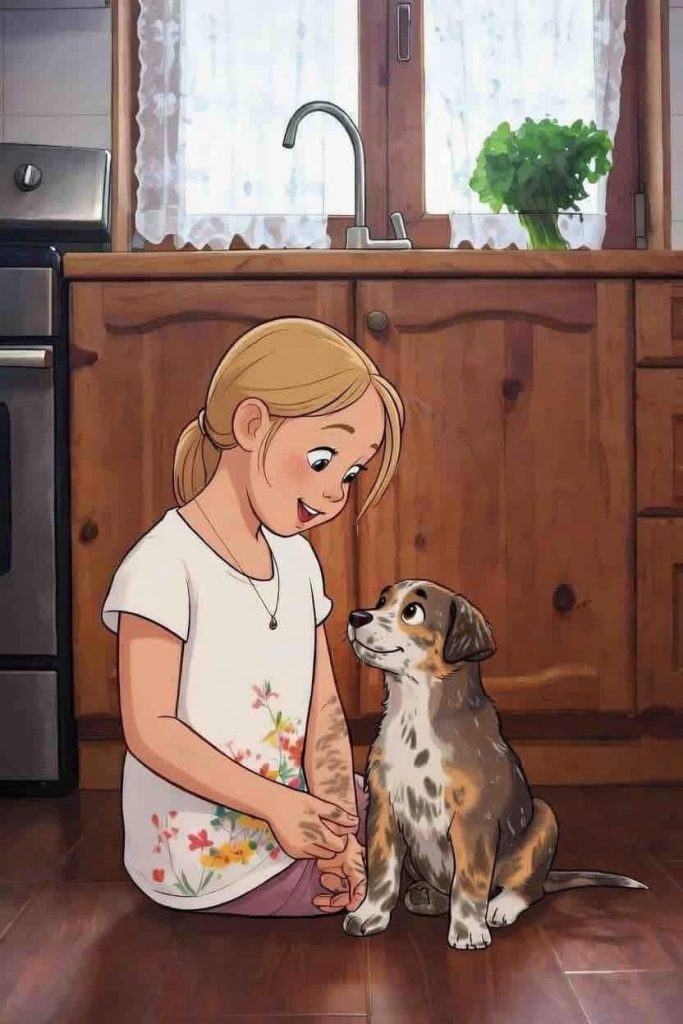
“A Little Muddy Surprise”
(© all rights reserved )
In the little yellow house on Maple Street, where the kitchen always smelled of cinnamon toast and fresh laundry, six-year-old Laura discovered the most wonderful secret one rainy Tuesday afternoon.
She was supposed to be coloring at the table while Mama chopped onions for soup, but the back door had been left ajar just enough for a small, muddy shadow to slip inside. Laura heard the soft click of claws on the tile, turned, and gasped.
There, dripping and shivering, stood the scruffiest dog she had ever seen. He was no bigger than a loaf of bread, with one black ear flopped over like a broken umbrella and fur the color of wet cardboard. His eyes were huge and golden, and they looked straight at Laura as if to say, Please don’t send me back into the rain.
“Oh,” Laura whispered. “You’re lost.”
The dog tilted his head. A tiny drop of water fell from the tip of his nose and plopped onto the floor.
Laura glanced at Mama, who was humming and hadn’t noticed yet. Then she looked back at the dog.
“I’m going to call you Rafik,” she announced in her most serious six-year-old voice. “Because it sounds brave and kind of mysterious, and you look like you need a brave name.”
Rafik wagged his tail once—slow, uncertain, then faster, as if testing whether wagging was allowed in this bright, warm place.
Laura knelt down and patted the tile beside her. “Come here, Rafik. Shhh. We have to be very quiet so Mama doesn’t hear your paws yet.”
Rafik took one careful step. Then another. His wet fur brushed Laura’s knee and left a muddy streak on her pink leggings. She didn’t mind.
“You’re cold,” she said softly. “I can tell because your ears are all flat. When my ears get cold they do that too, but mine aren’t as fluffy.”
Rafik sat down right in front of her and lifted one paw, as if offering it for inspection.
Laura giggled and took the paw gently. “Hello, Mr. Paw. I’m Laura. I live here and I have a big brother who’s mean about sharing crayons, but I’ll share with you. Promise.”
Mama turned from the cutting board, knife paused mid-chop. “Laura, honey, who are you talking to?”
Before Laura could answer, Rafik sneezed—a huge, dramatic sneeze that sent droplets flying in every direction.
Mama yelped and jumped back. “Oh my goodness!”
Laura burst out laughing and threw her arms around Rafik’s damp neck. “This is Rafik! He came in from the rain and he’s my friend now!”
Mama stared at the tiny, filthy dog who was now licking Laura’s cheek with great enthusiasm. “Sweetheart… that’s a stray.”
“No, Mama,” Laura corrected solemnly. “He’s a foundling. That means the rain found him and sent him to our kitchen so we could love him.”
Rafik barked once—a small, hopeful sound—and then, as if he understood he was being discussed, he did a little hop and spun in a circle, tail whipping like a propeller.
Laura clapped. “See? He’s doing tricks already!”
Mama tried to look stern, but the corners of her mouth kept twitching. “We can’t just keep a dog, Laura. He probably belongs to someone.”
“He doesn’t have a collar,” Laura pointed out reasonably. “And look—he’s so skinny you can see his ribs doing the wave when he breathes. Ribs aren’t supposed to wave, Mama.”
Rafik, perhaps sensing the negotiation, trotted over to the open pantry door, sniffed the bag of kibble Mama bought for the neighbor’s cat, and looked back at them with such perfect longing that even Mama laughed out loud.
“All right, all right,” Mama said, wiping her hands on a dish towel. “But first he needs a bath. And you, young lady, are helping.”
Laura squealed with delight.
They filled the kitchen sink with warm water. Rafik looked suspicious at first, but when Laura climbed onto a stool and gently poured a cup of water over his back, he sighed—a long, dramatic dog sigh—and leaned into her hands.
“You’re being so brave,” Laura whispered as she worked shampoo into his fur. “Like a knight in a story. A very small, very dirty knight.”
Rafik sneezed bubbles.
Laura giggled so hard she almost fell off the stool. “Rafik! You made a bubble beard!”
Mama, who was supposed to be supervising, started laughing too—real, helpless laughter that made her shoulders shake.
“Stop—stop making him sneeze bubbles!” Mama gasped, wiping her eyes. “I can’t chop onions when I’m crying from laughing!”
But Rafik was just getting started. He shook himself—once, twice, three times—sending soap suds and water flying in a glorious arc. Laura shrieked and ducked. Suds landed on Mama’s apron, on the fridge, even on the cookie jar shaped like a rooster.
“Rafik!” Laura cried, delighted. “You’re making it rain inside!”
Rafik barked happily, tail wagging so hard his whole back end wobbled. Then he planted his front paws on the edge of the sink, stretched up, and licked Laura square on the nose.
Laura laughed so loudly it echoed off the cabinets. “He kissed me! Mama, he loves me already!”
Mama finally gave up pretending to be serious. She scooped the dripping dog out of the sink, wrapped him in the oldest towel she could find, and set him on the floor. Rafik immediately raced in crazy circles around Laura’s legs, trailing the towel like a cape.
“Look at him go!” Laura shouted. “He’s a superhero! Captain Rafik!”
Mama leaned against the counter, arms crossed, watching her daughter and the ridiculous muddy dog chase each other around the kitchen island. Her laughter bubbled up again—warm and unstoppable.
“You two,” she said, shaking her head. “You’re going to be the death of me.”
Laura skidded to a stop in front of her mother, cheeks pink, eyes shining. “Can he stay, Mama? Please? He’s the best foundling in the whole world.”
Rafik sat down beside Laura, tilted his head, and gave one soft, hopeful woof.
Mama looked from the little girl to the little dog and back again. Then she sighed the happiest kind of sigh.
“Fine,” she said. “But he sleeps in the laundry room tonight until we get him a proper bed. And tomorrow we’re putting up posters, just in case.”
Laura threw her arms around Mama’s waist. “Thank you thank you thank you!”
Rafik barked once—short, triumphant—and then leaped up to lick Mama’s hand.
Mama ruffled his damp ears. “You’re trouble, little man. Both of you.”
But as Laura and Rafik raced around the kitchen one last time—Laura giggling, Rafik yipping, the towel-cape flapping—Mama didn’t stop smiling.
And in that warm, cinnamon-scented kitchen, on an ordinary rainy Tuesday, an unusual friendship was born: one small girl and one very small, very brave foundling, already certain they belonged to each other forever.
—Erika P. Hamlet
xxxxxxxxxxxxxxxxxxxxxxxxxxxxxxxx